/
Free Trial → Paid Conversion
The right trial length isn't a convention. It's a calculation. Set it too short and users never reach the value that would make them pay. Set it too long and urgency disappears before a decision gets made.
what would you do?
Your 14-day free trial has great activation and strong daily engagement. But almost nobody converts when the trial ends. What's most likely broken?
Users are clearly getting value. So why aren't they paying?
A
The trial is too short. Extend it to 30 days so users have more time.
B
Users hit the paywall moment without ever encountering a real reason to upgrade: too much access, no upgrade trigger.
C
Your reminder emails aren't landing. Add more touchpoints in the final 48 hours.
D
The pricing is too high. Run a discount experiment at trial end.
The Problem
Trial length is usually set by convention. Someone looked at what competitors do, picked a number, and moved on. But the right length isn't a convention. It's a function of of how long it takes a user to experience your product's core value once, and ideally repeat it. Set the trial shorter than that window and users never form a reason to pay. Set it longer and the end-of-trial decision loses urgency.
The data backs this up in ways that cut against conventional wisdom. RevenueCat's 2026 subscription-app benchmarks show that trials lasting 17 to 32 days convert materially better than ultra-short trials, yet nearly half of apps now use trials of four days or less, largely to speed up revenue recognition and experiment cycles. The consequence shows up in cancellation behavior: the majority of cancellations on 3-day trials happen on day zero, before the user has experienced anything at all. [2]
In B2B, median free-to-paid sits at 8%, but the variance is huge. A no-card trial at 4 to 6% is healthy. A card-required trial at the same rate is failing. Those should convert at 25 to 35% when trust and access design are right. Length is rarely the constraint. The paywall design usually is. [1]
Category matters more than any benchmark. Education and Lifestyle apps convert over 40% of trialists. Gaming converts around 19%. Health and Fitness users often pay upfront with no trial at all. The rule: if value is immediate and habit-linked, trials can be shorter. If the ca
The Solution
The real question isn't "how long should the trial be?" It's "how long until a credible aha moment?" Set the trial just long enough for users to experience paid value once, then design the paywall to feel like a natural next step rather than a surprise at the end. [4]
The Decision Rule for Trial Length
Match the trial window to setup burden, usage frequency, and trust required:
7 days: Daily-use product, aha moment is immediate, value is clear after a few sessions. Only works if onboarding reliably activates users in session one.
14 days: Self-serve B2B SaaS with moderate setup. Two realities align: 14 days is the most common B2B trial length, and conversions often cluster around day 7, leaving one week to activate and one week to reinforce.
30 days: Value builds across repeated use, calendar cycles, or habit formation. Consumer fitness, wellness, and design tools often need this window before users have formed a routine worth paying to keep.
60 to 90 days: Implementation is the product. Integrations, data migration, admin approvals, and team rollout require this window. At this point you are running a pilot, not a trial.
No trial: A strong free tier already demonstrates core value, or a hard paywall plus clear positioning converts better than letting users wander unactivated.
Card gating is a quality filter, not a universal lever. Card-required trials convert roughly 5x higher than no-card trials in B2B, but only when the product justifies the commitment at first touch and the start screen is explicit about billing dates, reminders, and cancellation. [1]
The reverse trial combines trial urgency with freemium's long-tail potential. Users start on full premium, then fall back to a permanent free tier rather than losing access entirely. It avoids the "pay or lose everything" cliff that makes standard trial expiry feel adversarial. [4]
Real Examples
Showing What Happens Next Before Asking for a Card
A three-date timeline answers every billing question before the card field appears, removing hesitation at the highest-friction moment

Riverside
The design decision
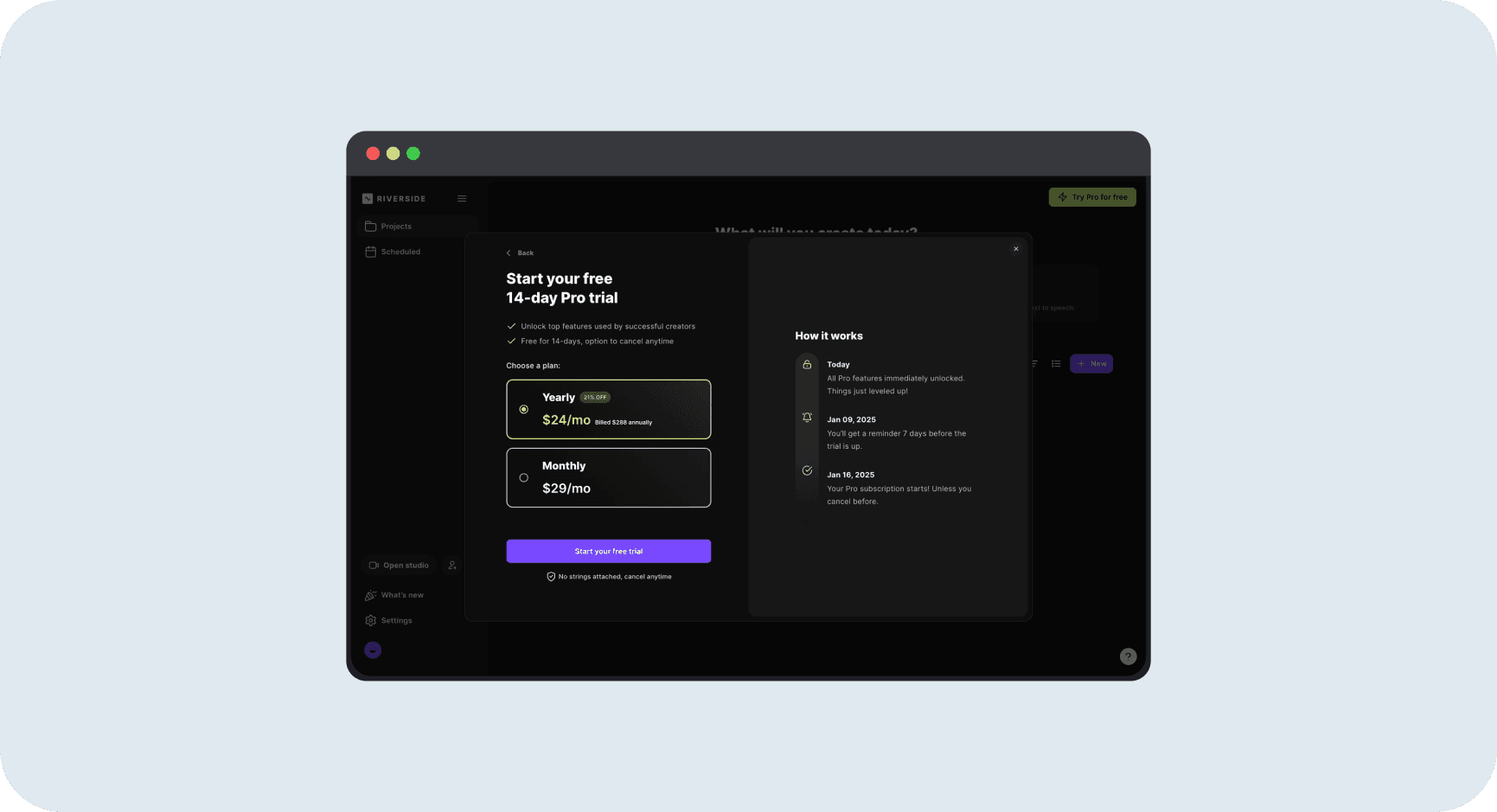
Riverside's trial modal shows the plan selector and billing timeline side by side before users commit. On the right: three dated steps. Today, all Pro features unlock immediately. On January 9, a reminder arrives 7 days before the trial ends. On January 16, the Pro subscription starts unless cancelled. The CTA button says "Start your free trial" with "No strings attached, cancel anytime" below it. The pricing ($24/mo yearly, $29/mo monthly) is visible before any card details are entered.
Why it works
The modal answers the three questions users ask before entering card details: when does the trial end, will I get a warning, and when does billing start? Showing exact dates (not "in 7 days" or "soon") makes each answer concrete rather than vague. By the time someone reaches the card field there's nothing left to hesitate about. Card-required trials convert significantly higher than no-card trials, but only when users trust the process. The timeline is what builds that trust before asking for anything.[1]
Using a Visual Timeline to Make a 7-Day Trial Feel Safe
A short trial works when the timeline, social proof, and discount all appear on the same screen before users commit
Letting Users Configure Their Plan Before the Trial Starts
Showing the exact post-trial price before commitment removes the most common reason B2B users hesitate to start
Trial Models by Product
The right trial model depends on product type, acquisition intent, and what you're optimizing for. This table synthesizes patterns from ChartMogul, RevenueCat, OpenView, and official product documentation. [1]
Product Type | Recommended Model | Length | Card Required? | Key Metric |
|---|---|---|---|---|
B2B Self-Serve SaaS | Full access, no card | 14 days | No | Paid customers per 1,000 visitors |
B2B Enterprise SaaS | Pilot or proof-of-concept | 60 to 90 days | No (sales-led) | Trial-to-paid in 30 to 60 days |
Consumer Subscription App | Full access, card required | 7 to 14 days | Yes | Trial-to-paid; day-0 cancellation rate |
Prosumer / Design Tool | Full access, card required, transparent timeline | 7 to 30 days | Yes | Trial-to-paid; early cancellation rate |
Freemium with Premium Tier | Reverse trial: premium first, downgrade after | 14 days | No | First-month conversion; D90 long-tail |
E-commerce SaaS | Full setup access, gate at "go live" moment | 3 to 14 days | No | Store-configured-to-paid conversion |
Mistakes That Kill Success
avoid this
Gating the Feature That Creates the Aha Moment
If users need a feature to experience core value, locking it during the trial removes the reason they'd ever upgrade. A security product that gates security scanning, an analytics tool that gates its reports, and both create trials where users evaluate a stripped version rather than the real thing. Activation and conversion both suffer. [4]
Fix
Audit every gated feature against one question: does a user need this to believe the paid product is worth paying for? If yes, make it accessible during trial, potentially with usage limits rather than hard locks.
avoid this
Optimizing Trial-to-Paid Rate While Ignoring Signup Volume
A card gate can lift trial-to-paid from 5% to 30%, but if it cuts signups by 80%, you end up with fewer total paid customers. The metric that matters is paid customers per 1,000 visitors, not conversion rate in isolation. [1]
Fix
Run any card-gating experiment with both conversion rate and total paid customers as primary metrics. If the card gate increases one while decreasing the other, measure the net revenue impact before declaring a winner.
avoid this
Hiding Billing Terms Until After the Card Is Entered
Surprise charges don't just cause cancellations. They cause disputes and lasting damage to trust. California's auto-renew rules (effective July 2025) make pre-charge disclosure a legal requirement for trials over 31 days, not just a UX best practice. [8]
Fix
Show the billing date, the charge amount, and the cancellation path before users enter card details. The Canva timeline pattern (today, reminder date, charge date) answers every billing question before the user has a reason to hesitate.
Metrics That Matter
Trial Conversion Metrics
Track conversion at multiple windows. A 14-day no-card trial spikes around day 7 and at expiry. A reverse trial spikes at downgrade, then again at 30 and 90 days as feature gaps accumulate. [1]
Core Formulas
Trial-to-paid = paid conversions from trial cohort / trial starts
Paid customers per 1,000 visitors = total paid / (visitors / 1,000)
Paywall conversion = upgrades from paywall / paywall impressions
Benchmarks by Model
No-card free trial: 4 to 6% is good, 10 to 15% is great. Credit-card trial: 25 to 35% is good, 50 to 60% is great. Freemium: 3 to 5% is good. The gap between models is large, but total paid customers per visitor is the number that actually tells you which model is working. [1]
Activation and Retention Metrics
Trial conversion is downstream of activation. If users haven't hit your activation milestone before the trial ends, the expiry decision will always feel premature. [4]
The Opportunity
5x
The conversion rate advantage of credit-card-required trials over no-card trials in aggregate B2B data, but only when trust is preserved through billing transparency and easy cancellation paths [1]
Day 7 Is When It Happens
Trial conversions in B2B SaaS cluster around day 7, not at the end of the trial period. If users haven't encountered a reason to upgrade in week one, extending the trial delays the same decision rather than improving it. [9]
Longer Trials Convert Better in Apps
RevenueCat's 2026 data shows trials of 17 to 32 days convert at roughly double the rate of trials of four days or less. Yet nearly half of apps use ultra-short trials, prioritizing speed of revenue recognition over conversion quality. [2]
Most Cancellations Happen Immediately
On 3-day trials, the majority of cancellations happen on day 0, before the user has experienced anything. The trial is too short to survive the initial uncertainty about whether it will charge them unexpectedly. [2]
Paywall After Value Converts 3 to 5x Better
Users who experience core value before hitting a paywall are significantly more likely to convert than users who encounter the paywall first. The sequence matters as much as the timing. [4]
Resources Worth Your Time