/
Pricing & Monetization
Pick the right number of tiers so customers find the best fit fast, while you maximize revenue. Too many plans confuse. Too few leave money on the table.
what would you do?
Your SaaS pricing page has 5 tiers. Conversion dropped from 9% to 4.8% after launch.
Analytics show users spend 52 seconds comparing tiers before bouncing. Heatmaps reveal constant scrolling between columns. Your product team loves the segmentation. Your growth team says it's destroying conversions.
A
Add a 6th tier to fill the gap between "Pro" and "Enterprise"
B
Consolidate to 3 tiers (Starter, Pro, Enterprise) with "Most Popular" badge on Pro
C
Keep 5 tiers but redesign with better visual hierarchy and colors
D
Hide 2 tiers behind a "See all plans" dropdown to reduce clutter
The Problem
The Solution
The 3-Second Clarity Test
Place a crystal-clear, benefit-driven tier structure above the fold that instantly tells visitors which plan fits them, what it does, and why it's awesome [3][4]. Skip jargon, focus on customer outcomes, and back it up with proof.
Formula:
We help [target audience] [achieve benefit] without [pain point]
Patterns for High-Converting Pricing Structures

Netflix
How they do it
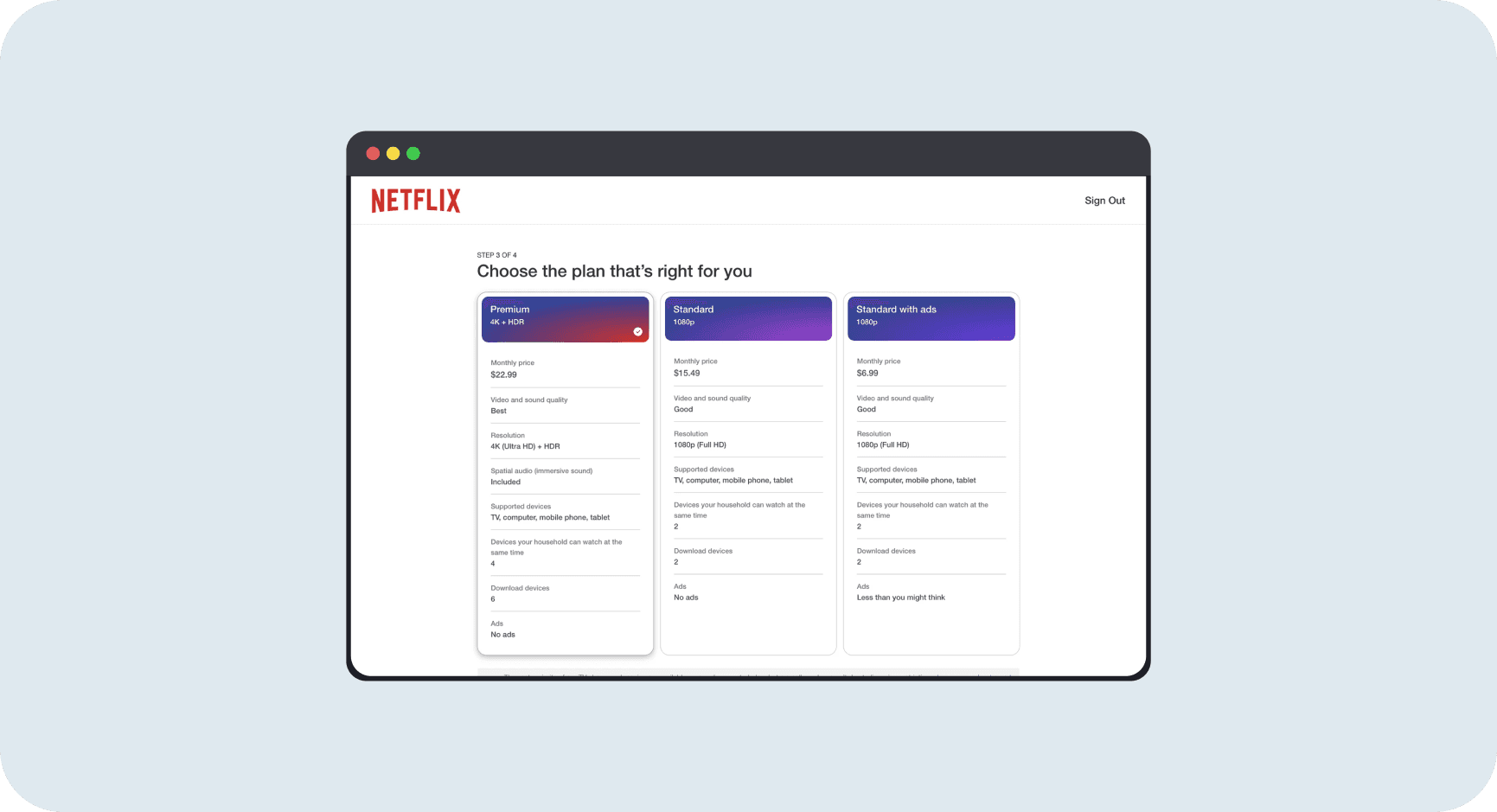
Netflix presents three plans side-by-side: Premium ($22.99), Standard ($15.49), and Standard with ads ($6.99). The Premium tier gets a purple-to-red gradient header with a white checkmark, making it visually dominant. Each card shows resolution (4K+HDR, 1080p), video quality (Best, Good), supported devices, simultaneous streams, and download limits. Features are stacked vertically with clear labels, making differences instantly scannable.
Why it works
The gradient header and checkmark create visual hierarchy without saying "Most Popular." Premium draws the eye first, making it the anchor. Clear feature differentiation (4K vs 1080p, 6 vs 2 downloads) helps users self-select. The middle Standard plan becomes the sweet spot between Premium and the ad-supported tier. This structure drove ARPU from $7.99 to $20+ through gradual increases [13].
Pricing Structure by Product Type
Different products require different tier approaches. Match your structure to your product type and customer segments.
Product Type | Optimal Tiers | Tier Approach | Example |
|---|---|---|---|
B2B SaaS | 3 tiers | Starter, Pro (popular), Enterprise | Slack, Notion |
Consumer Apps | 2-3 tiers | Free + Premium OR Free + Plus + Ultra | Spotify, Tinder |
Content Platforms | 2-3 tiers | Free/Basic, Standard (popular), Premium | Netflix, YouTube |
Productivity Tools | 1 or 3 tiers | Single flat rate OR tiered by team size | Basecamp, Asana |
Marketplaces | 2 tiers | Free + Premium seller features | Etsy, eBay |
Mistakes That Kill Success
avoid this
Too Many Tiers Paralyze Buyers
Offering 4+ plans kills conversions. "Beyond two or three options, things go downhill. Too many choices lead to indecision and lower sales" [3]. Every extra tier adds cognitive load and comparison time.
Fix
Consolidate to 3 tiers maximum. Use "Good-Better-Best" structure. Mark the middle tier "Most Popular" to guide choice [9]. If you need segmentation, use add-ons instead of separate tiers.
avoid this
Feature Lists Without Benefits
Listing features without tying them to benefits confuses visitors. They care more about outcomes than technical specs [19].
Fix
Translate features into benefits. Instead of "5TB storage," say "Store your entire company's files." Instead of "Advanced analytics," say "Know exactly where your traffic comes from."[20]
avoid this
No Visual Guidance on Best Option
When all tiers look identical (same size boxes, same button colors), buyers freeze. Missing the "Most Popular" or "Best Value" badge eliminates your easiest conversion lever [9].
Fix
Visually emphasize your recommended tier. Use "Most Popular" badges, make the CTA button larger or different color, add a subtle highlight or border. Guide the decision, don't leave it to chance.
Metrics That Matter
Pricing Page Conversion Rate
Percentage of pricing page visitors who select a plan. Strong pricing converts directly. [23][24]
Benchmark
Typical: 5-10%. Top performers: 15%+ [23][24]
Related Metrics
Time on Pricing Page, Plan Selection Distribution, Bounce Rate from Pricing
Test tier count (3 vs 5) to find optimal structure
A/B test "Most Popular" badge placement
Compare annual vs monthly billing as default
Remove confusing jargon from tier names
Free-to-Paid Conversion Rate
For freemium models: percentage who upgrade to paid. Clear tier differentiation drives upgrades. [12]
Average Revenue Per User (ARPU)
Monthly revenue divided by active users. Pricing structure directly impacts ARPU growth. [6][7]
The Business Impact
60%
ARPU growth over 5 years from regular pricing updates. Companies tweaking prices annually grow revenue 30-60% more than static pricers[7].
Tier Optimization
Moving from 5 to 3 tiers can boost conversions 50%+. Analysis paralysis costs real revenue. Simplifying structure = immediate lift [3].
Premium Tier Addition
Tinder's expansion from 1 to 3 paid tiers generated "hundreds of millions" in incremental revenue. Capturing high-ARPU segments unlocks massive growth [4].
Price Testing Yields 5-15% Lifts
Small pricing optimizations routinely deliver 5-15% revenue increases. AllTrails raised annual price $6 and saw 8.3% ARPU lift. Low-cost, high-impact lever [5][6].
Netflix ARPU Growth
Netflix grew ARPU from $7.99 to $20+ through gradual price increases over years. Their 3-tier structure with "Most popular" badge drove systematic upgrades [13].
Resources Worth Your Time
Frameworks & Positioning
Testing & Optimization