/
Pricing & Monetization
Transform pricing from a guessing game into a strategic growth lever that aligns with customer value and drives expansion revenue.
what would you do?
You're launching a new collaboration tool. Teams use it together, and value clearly scales as more people join.
You're deciding between three pricing models. Which one will drive the highest long-term revenue?
A
Flat $99/month for unlimited users
B
$15/user/month (standard per-seat pricing)
C
Free for viewers, $15/month per editor
D
Usage-based pricing per action consumed
The Problem
Companies set pricing that's either too complex, misaligned with product value, or stuck in legacy models. The wrong pricing hampers growth, confuses users, and leaves massive revenue on the table. Many default to competitor pricing or never revisit their initial structure, leading to churn and stalled expansion.
The Solution
Strategic Pricing Alignment
Choose a pricing structure (usage-based, per-user, tiered) that mirrors how customers derive value. Learn from successful SaaS businesses, adopt simple value-driven plans, and continuously refine through data [1][2].
Key Principle:
Price on the metric that scales with customer success
Examples:
Postmark charges per email sent, aligning cost with actual usage
Figma uses per-editor pricing, scaling naturally with active contributors
Common Pricing Models and When to Use Them

Postmark
How they do it:
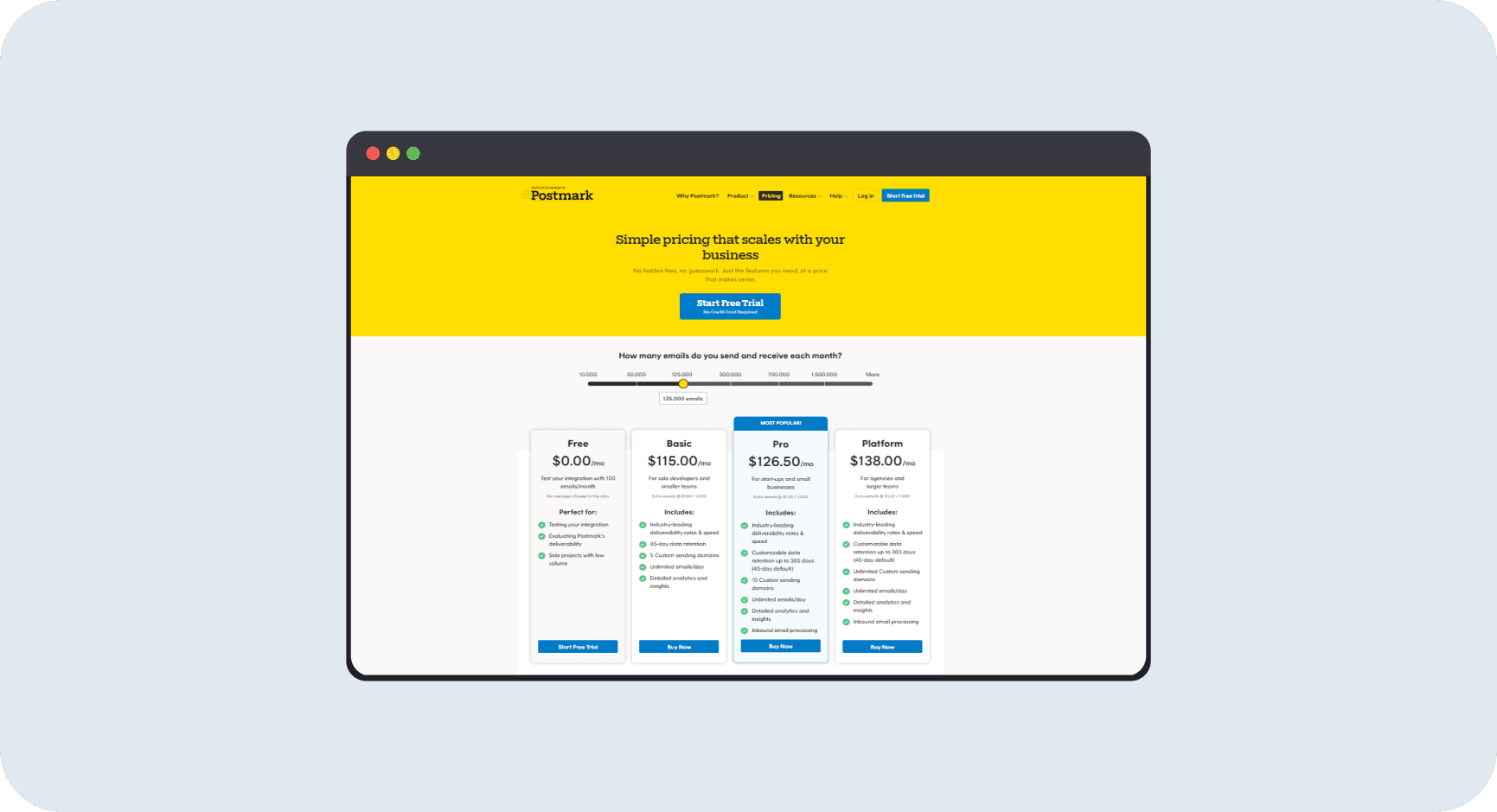
Postmark uses a hybrid model with tiered packages (Free, Basic, Pro, Platform) that include set email volumes, then charges for overages. The key insight: pricing scales with email volume using a slider ("How many emails do you send and receive each month?"). No hidden fees, no guesswork, just transparent volume-based pricing.
Why it works
The interactive slider lets customers self-select their tier based on actual usage. Developers testing with 100 emails start free. Growing businesses sending 125,000 emails see exactly what they'll pay ($126.50/mo). The model removes uncertainty while ensuring customers only pay for what they need. As email volume grows (business success), Postmark revenue grows naturally. The transparency builds trust and eliminates switching anxiety.
Tiered Pricing
Multiple plans (Basic, Pro, Enterprise) at different price points with increasing features. Segments market and creates upgrade paths [11][12]
Pricing Model Fit by Product Type
Match your pricing structure to your product's value delivery and user behavior:
Product Type | Best Model | Why It Works | Example |
|---|---|---|---|
Infrastructure / APIs | Usage-Based | Variable demand, scales with customer growth | Stripe, Twilio, AWS |
Collaboration Tools | Per-User | Value increases with team size | Slack, Linear, Figma |
Productivity Software | Tiered + Per-User | Different feature needs across segments | Notion, Asana |
Developer Tools | Freemium + Usage | Low barrier entry, monetize power users | GitHub, Vercel |
Enterprise Software | Tiered + Custom | Complex needs, negotiated contracts | Salesforce, Workday |
Mistakes That Kill Success
avoid this
Overcomplicating Pricing Plans
Too many tiers or convoluted feature matrices confuse customers and burden sales teams. One SaaS company cut from 12 packages to 5 and saw deal sizes increase 15-30% [15].
Fix:
Streamline to 3-4 clearly differentiated tiers that map to distinct customer segments. Make each tier's value immediately understandable. Simpler pricing means less friction and easier decisions.
avoid this
Misaligned Value Metrics
Pricing units that don't match how customers derive value stifle growth. Charging per user when value comes from transactions (or vice versa) creates friction [16].
Fix:
Identify what usage or outcome correlates most with customer success and price against that. Do customer research to test different metrics. The right one should scale with usage but remain predictable for budgeting.
avoid this
Failing to Evolve Pricing
Markets change, products evolve, but many companies set pricing once and forget it. Clinging to outdated models means leaving money on the table or losing competitiveness [17].
Fix:
Treat pricing as continuous experimentation[18]. Revisit annually or after major product changes. Use A/B testing, pricing surveys, and market monitoring to adjust proactively.
Metrics That Matter
Average Revenue Per User (ARPU)
Direct indicator of how well you're monetizing your customer base. Rising ARPU means effective pricing strategy [19].
What to Track
Monitor by segment and over time. Look for upward trends from upsells and plan migrations.
How to Measure
Total MRR divided by number of customers. Break down by customer cohort and plan tier.
Related Metrics:
Customer Lifetime Value (LTV), Expansion MRR, Net Revenue Retention
Improvement Tactics:
Introduce higher-tier plans with premium features
Add usage-based components to capture expansion
Focus on customer success to drive upgrades
Implement value-based pricing increases
CAC Payback Period
Months to recover customer acquisition cost. Shorter payback means pricing returns investment quickly [20].
Net Revenue Retention (NRR)
Combines expansions and churn. NRR above 100% means upsells outpace losses, hallmark of successful pricing [21].
Business Impact of Strategic Pricing
54%
Usage-based SaaS companies achieve 54% higher revenue growth at scale compared to traditional subscription models [22][23]. Strategic pricing changes drive expansion revenue, retention, and sustainable growth.
Landbot: +26% Net Revenue Retention
Switched to usage-based pricing tied to chatbot engagement. Heavy users paid more (happily), light users paid less. Unlocked expansion revenue from largest customers while improving satisfaction[24].
Usage-Led Growth Advantage
Companies like Snowflake and Twilio leverage usage pricing for best-in-class retention (often >120% NDR). Revenue naturally expands within accounts as customers succeed [25].
Slack's Fair Billing Trust
Automatically credits customers for inactive users. This "fair billing" policy encouraged wide rollout without fear of overpaying. Built trust, drove viral expansion, achieved massive enterprise penetration with low churn.
Resources Worth Your Time
Strategic Guides
Case Studies & Examples