/
Onboarding & Activation
Turn skeptical newcomers into engaged users by engineering an early win that demonstrates your core value.
what would you do?
Your product has a 35% Day 1 activation rate. You want to hit 50%.
Your team proposes four improvements. You only have engineering time for ONE sprint. Which do you ship first?
A
Build an interactive product tour that highlights all key features
B
Add a progress bar showing "3 of 7 setup steps complete"
C
Identify which user action correlates strongest with Week 2 retention, then optimize the path to it
D
Send a personalized onboarding email with tips 2 hours after signup
The Problem
Your users sign up with excitement, then disappear. They get lost, overwhelmed, or confused before experiencing real value. Without reaching a meaningful outcome fast, they simply won't return [1][2]. This shows up as poor Day 1 retention, abandoned onboarding flows, and features that never get used.
The Solution
The 5-Minute Value Delivery
Design an onboarding flow laser-focused on one thing: getting users to their first win as fast as humanly possible. Identify the simplest action that showcases your unique value, then remove every barrier between signup and that moment.
Formula:
[Product] helps new users [achieve quick win] without [friction/confusion]
Patterns That Accelerate the Aha Moment
Instant Gratification
People crave immediate rewards. The sooner they feel accomplishment, the more dopamine they get to continue [3][4].

Duolingo
How they do it:
You jump straight into a beginner lesson within seconds. No forms, no explanations [2]. The lesson is short, visual, and designed so everyone succeeds. Right after, you see your score, hear positive sounds, and see your streak count of 1.
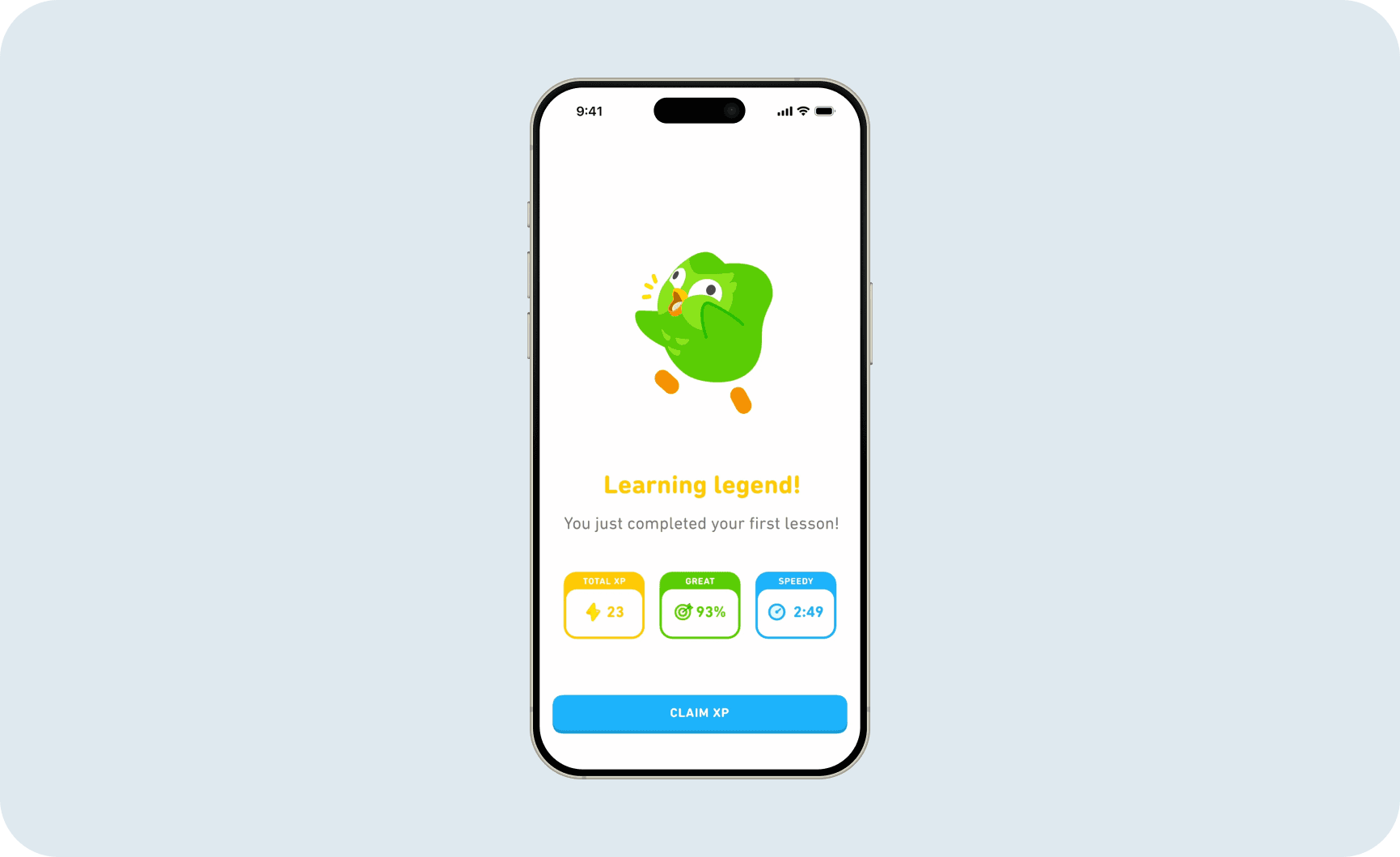
Result
Even a 5% increase in Week 1 retention lifts Week 10 retention by nearly 20% [2]. That first lesson aha moment compounds into long-term engagement.
Personalized Guidance
Tailor the path to each user's goal. When it feels personally relevant, they'll engage deeper and faster [8][9].
Guided Momentum
Keep users moving forward with clear next steps and social proof. Never let them feel stuck or alone [16][17].
Product Type Framework
Different products need different tactics to deliver first success. Match your strategy to your product model:
Product Type | First Success Moment | Key Tactic | Example |
|---|---|---|---|
Solo Productivity | Complete first task/note | Pre-fill templates, quick add flows | Notion, Evernote |
Collaboration | First shared interaction | Invite prompts, demo teammates | Slack, Figma, Miro |
Content Creation | Publish first piece | Templates, drag-and-drop | Canva, Webflow |
Communication | First message/video sent | Simplified recording, instant share | Loom, WhatsApp |
Data/Analytics | See first insight | Sample data, auto-charts | Amplitude, Mixpanel |
Mistakes That Kill Success
avoid this
Forcing Users Through Lengthy Signup
Requiring too many form fields kills momentum. Users want to see value, not fill out their life story. Every extra field is a chance to drop off [4].
Fix:
Streamline to under 3 steps [4]. Offer social login. Get them into the app quickly. You can collect more info later once they're engaged.
avoid this
Overwhelming with Tours and Tooltips
A 12-step product tour creates cognitive overload [6]. Users click "Next, Next, Finish" without absorbing anything, or worse, feel intimidated and abandon.
Fix:
Focus on just-in-time guidance. Use short tours (3 steps max)[6]. Completion rates drop sharply beyond a few steps. Guide only to the next key action that leads to value.
avoid this
Asking for Upgrade Before Value
Prompting users to pay or invite colleagues before they've seen value creates disconnect [8]. It's like asking for checkout before trying on shoes.
Fix:
Demonstrate value first, then ask for commitment. Time upgrade prompts right after an aha moment when users are delighted and clearly see the benefit.
Metrics That Matter
Activation Rate
Percentage of new users who reach the aha moment within a given timeframe. This directly tells you if your onboarding works [9].
Benchmark
30-50% within 48 hours for strong products
How to Measure
Define key actions that mean activation (e.g. completed profile + first project). Track what fraction complete these steps after signup [9].
Related Metrics:
Time to Value, Day 1 Retention
Improvement Tactics:
Remove friction points in onboarding flow
Add progress indicators and celebrate milestones
Personalize the path based on user goals
Provide templates or sample data to speed value delivery
Time to Value (TTV)
How quickly users reach the aha moment from signup. Shorter TTV means users get value faster, leading to better retention [10].
First Action Completion Rate (FACR)
Percentage of new users who complete the first meaningful action in their very first session. This is the earliest measurable signal that users understand what to do and feel confident enough to act.
The Strategic Opportunity
2x
Companies that excel at first success moments see dramatically better results: double the retention, higher conversion rates, and more referrals [12]. Users who reach aha quickly stick around, upgrade, and tell others.
Higher Conversion
Users who experience value are primed to pay. Fast activation leads to more trial conversions and upgrades with better unit economics [10].
Viral Growth
Excited users tell others and invite colleagues. Each activated user can snowball into several more through referrals and word-of-mouth.
Lower Support Load
Smooth activation creates happier users with fewer questions. They need less hand-holding, freeing teams to focus on expansion.
Resources Worth Your Time
Best Practices & Frameworks
Case Studies & Examples