/
Free Trial → Paid Conversion
Trial design is one of the highest-leverage conversion levers. Get it right and users reach activation, understand premium value, and upgrade naturally. Get it wrong and they downgrade confused or feeling tricked.
what would you do?
Your 14-day trial gives full feature access. Users activate, engage daily, then downgrade when it ends. What's broken?
You're getting great activation but zero conversions. Choose the root cause:
A
Trial is too short. Need 30 days.
B
Missing credit card gate. Low-intent users diluting conversion.
C
Too much access without upgrade momentum. Users never hit a reason to pay.
D
No reminder emails before trial ends.
The Problem
Trial feature access fails when it forces users to choose before value is experienced, or when it gives so much away that users never feel the need to pay. [1]
The 2026 benchmark research covering 200 B2B software products shows median free-to-paid conversion at 8%, but with massive variance. Top performers convert 5x better by nailing feature access timing. [2]
The harsh reality: trial conversions peak in week one, with many clustering around day 7 when trials end. If users haven't hit meaningful value before the paywall decision point, last-day pressure converts nobody. [3]
The Solution
The core mechanics of high-performing trials: users must reach a value moment, then encounter a paywall that feels like a natural next step rather than a betrayal. [4]
The 3-Second Clarity Test for Trial Access
A user should immediately know:
1) What do I get right now? (full access, limited features, or limited usage)
2) What is locked, and what triggers the lock? (feature badge, limit meter, expiration date)
3) What happens when the trial ends? (downgrade, read-only, paused account)
4) When will I be charged and how do I avoid surprise charges? (timeline + reminder + cancel path)
A practical rule: do not gate features required to experience core value. If a feature helps users "get it," make it accessible during trial, potentially with usage limits. [5]
Real Examples
Gate the Monetization Moment, Not Setup
Let users build, but require payment to activate selling [6]

Shopify
How they do it
Shopify lets users build their entire store during a free trial without requiring payment. The interface shows "Your trial just started" and guides users through a "Setup guide" with tasks like "Add products," "Set up your online store," and "Launch your online store." A banner offers: "Extend your trial for $1/month for 3 months on select plans." The trial allows full store configuration (products, themes, settings), but checkout remains inactive. To start selling and accept payments, users must select a paid plan.
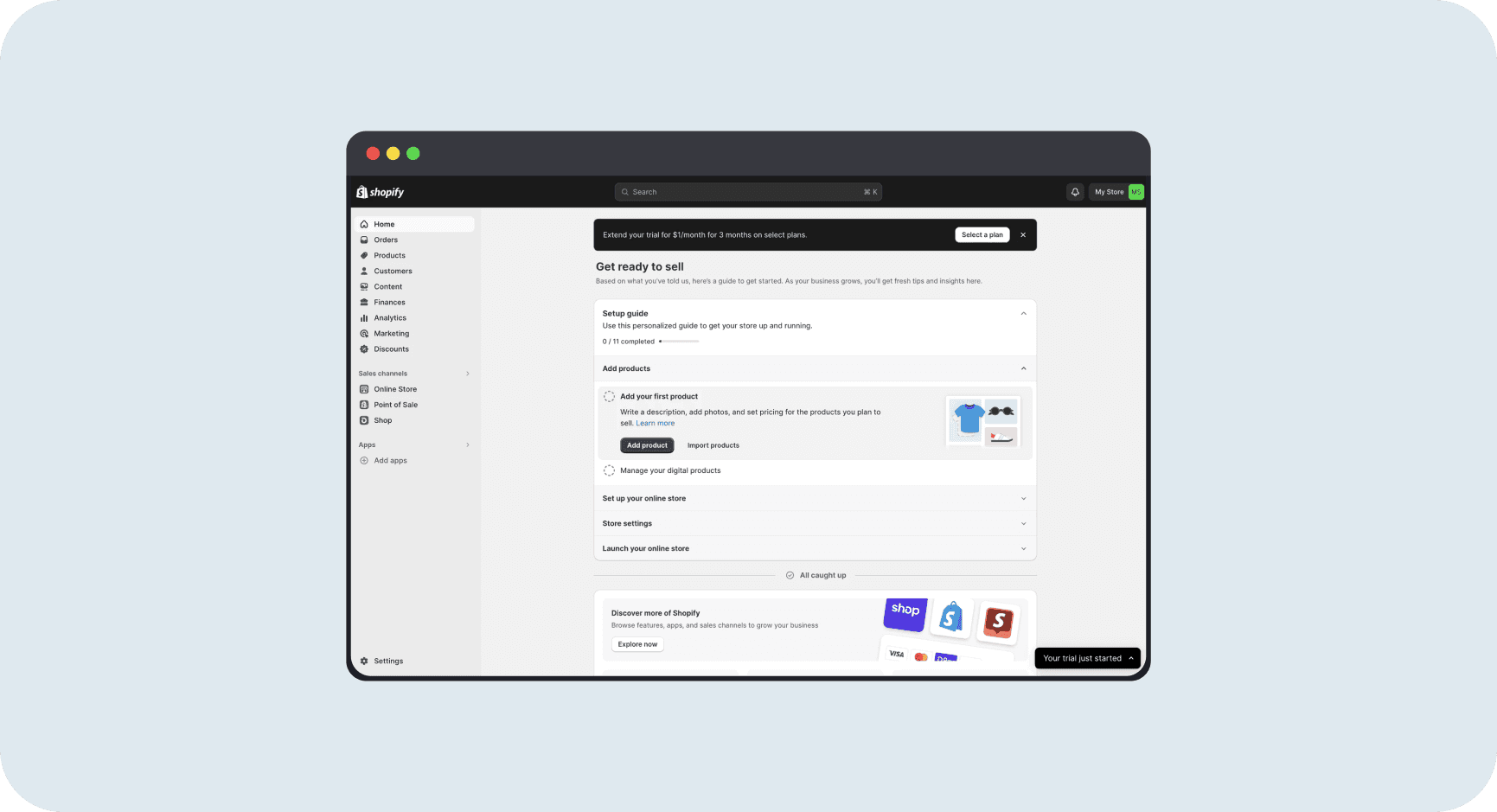
Why it works
It aligns access with user intent: "build first, pay when you're ready to sell." Setup isn't blocked by payment friction, which increases activation. The paywall triggers at a psychologically fair point when value is clear and the next step has meaningful business impact. Users don't feel tricked because they chose when to make money, and Shopify simply requires payment to enable that.
Premium Badges + Trial Transparency
Make "what is premium" obvious inside the workflow [7]
Reverse Trial: Premium First, Then Downgrade
Experience higher value workflow early, align paywall after activation [8]
Model Comparison
Choose your trial access model based on product type, cost structure, and what you optimize for: adoption or conversion. [9]
Product Type | Recommended Model | What to Gate | Key Metric |
|---|---|---|---|
B2B Enterprise SaaS | 14-30 day pilot with full core workflow | Scale, seats, governance; not core value features | Trial-to-paid in 30-60 days |
B2B Self-Serve SaaS | 14-day trial, no credit card (test CC if high costs) | Usage limits (credits, exports) over feature locks | Activation rate + trial-to-paid |
Consumer Freemium | Free tier + premium badges + paywall | Premium content/tools; keep basic loop usable | Day 1 paywall view rate (>80%) |
E-commerce SaaS | Full setup access, gate "go live" moment | Checkout activation, selling; not setup | Store configured → paid conversion |
Mistakes That Kill Success
avoid this
Gating the "Aha Moment" Behind a Paywall
If users need a feature to experience core value, locking it reduces activation and tanks trial-to-paid conversion. Example: gating security features in a security product. [10]
Fix
Audit paywalled features required to unlock core value. Make them free or accessible with usage limits (e.g., "3 scans/month" vs "scanning locked").
avoid this
Optimizing Trial-to-Paid % While Ignoring Signup Rate
Adding a credit card gate can boost conversion from 4% to 30%, but if signups drop 80%, you get fewer total paid customers. [11]
Fix
Measure paid customers per 1,000 visitors, not just trial-to-paid percentage. The real metric is total revenue, not conversion rate in isolation.
avoid this
Opaque Trial Rules and Surprise Billing
Hidden trial terms create distrust, cancellations, and refund requests. Users abandon trials when they're unclear about charges. [12]
Fix
Use a timeline paywall pattern: "Today: Start trial → Day 14: Trial ends → Day 15: You'll be charged $X unless you cancel. We'll remind you before Day 14." Transparency is a conversion lever, not a nice-to-have.
Metrics That Matter
Trial-to-Paid Conversion
The ultimate indicator: percentage of trial users who upgrade to paid plans. Track at multiple windows (14 days, 30 days, 60 days, 180 days) since conversions often cluster around day 7 (trial end), then taper sharply. [14]
Benchmark (2026, ChartMogul, n=200 B2B products)
Median free-to-paid across all products: 8% within 6 months
Good ranges by model: Freemium 3-5%, Free trial 4-6%, Credit card trial 25-35%
How to Measure
Formula: Trial-to-Paid = (Paid Conversions from Trial Cohort / Trial Starts) × 100
Track in your product analytics or payments platform by cohort start date
Activation Rate
Define activation as reaching your product's core value loop. Track whether users hit activation before day 7, not after the trial ends. Trial conversion is downstream of activation. [15]
Paywall Conversion
Measure conversion at the specific paywall moment: when users click a locked feature, hit a usage limit, or see an upgrade modal. This shows whether your paywall messaging and timing are effective, separate from overall funnel performance. [16]
The Strategic Opportunity
23%
Trial start rate increase from transparent billing timeline (Blinkist paywall pattern) [17]
Credit Card Trials
Convert 5x higher (30% vs 6%) but may reduce signup volume. Test in high-intent segments. [18]
Day 7 Peak
Trial conversions cluster around day 7. If users haven't hit value by then, extending trials just delays churn. [19]
Reverse Trials
Premium-first experience increases first-month conversion without losing long-tail conversions (Airtable pattern). [20]
Paywall After Value
Users who experience core value before hitting a paywall are 3-5x more likely to convert (OpenView PLG research). [21]
Resources Worth Your Time