/
Pricing & Monetization
The gate is not just a paywall. It is the packaging decision that determines which parts of your product are free, which are limited, and which become the reason someone pays. Get it wrong in either direction and you pay for it.
what would you do?
Your horizontal SaaS product is growing. The team wants to move most new features behind enterprise plans to improve ACV. What's the most likely unintended consequence?
Pick the root cause of what usually goes wrong with this approach:
A
Gating broadly useful features behind enterprise plans damages the developer or self-serve engine that was generating pipeline in the first place.
B
Enterprise buyers will expect those features to be included in their negotiated pricing anyway.
C
Enterprise plans become too complex to explain on a pricing page.
D
The product team loses the ability to iterate quickly on those features.
The Problem
Most feature gating fails for one of two reasons. The first is gating too early, before users have experienced why the product matters. Kyle Poyar's advice is direct: audit your packages for features users need to unlock core value, and consider making those free if they are not driving meaningful monetization. Casey Winters adds that if a feature drives virality or activation toward long-term retention, the economics often favor giving it away until activation is achieved. [1]
The second failure is gating the wrong thing entirely. Algolia is the clearest case study: moving broadly useful features to enterprise plans helped average contract value in the short term while quietly damaging the upstream self-serve engine that made those deals possible. The gate improved one metric while weakening the funnel that fed it. [2]
At the same time, giving away too much carries its own cost. OpenView's "free monster" warning describes how overly generous free products can anchor user expectations at zero, making any pricing feel like a betrayal. For cost-heavy products (particularly those with AI inference or data-intensive features), the right upgrade lever is often usage intensity or premium outcomes rather than hiding the core experience behind a hard wall. [7]
The real job is deciding where users have already seen enough value to accept a price boundary, then choosing the boundary most aligned to willingness to pay, cost to serve, and your go-to-market motion. [8]
The Solution
Reforge frames packaging around three dimensions: features, usage, and outcomes. The gate type you choose should follow from which dimension best matches where value actually compounds for your users. [1]
Gate Type | What is gated | Main risk | Best fit |
|---|---|---|---|
Hard gate | Access fully blocked until upgrade | Kills activation if placed before first value | Premium-only workflows users don't need to evaluate core value |
Soft gate | Feature visible, previewed, or partially usable | Can feel intrusive if shown too early or too often | Most self-serve SaaS features that benefit from teaser use |
Reverse trial | Paid functionality first, downgrade to free later | Requires careful downgrade design and cost control | Freemium products where paid value can be experienced safely |
Usage-based gate | Quantity, frequency, seats, storage, tasks | Thresholds feel arbitrary if not explained clearly | Products where more usage genuinely equals more value |
Role-based gate | Admin controls, governance, permissions | Confusing if seat logic is opaque | Team products, design tools, compliance-heavy workflows |
Freemium | Permanently free base tier with meaningful limits | Lower immediate conversion; ongoing free-user cost | Broad TAM, low marginal cost, strong viral or collaborative product |
Four durable rules for packaging decisions
1. Package around value, not org charts. Reforge recommends packaging by feature, usage, or outcome, not by what each internal team owns.
2. If a feature is broadly useful and helps users appreciate the product, it probably belongs in free or starter, with limits on scale rather than limits on access.
3. Reserve enterprise gates for things customers already expect to be enterprise-specific: security, SSO, admin controls, support tiers, and large-scale operational limits.
4. Treat freemium as an acquisition strategy, not the complete monetization strategy. The free plan earns the right to the upgrade conversation; it is not the end state.
Real Examples
Making the Limit Visible Before It Becomes a Problem
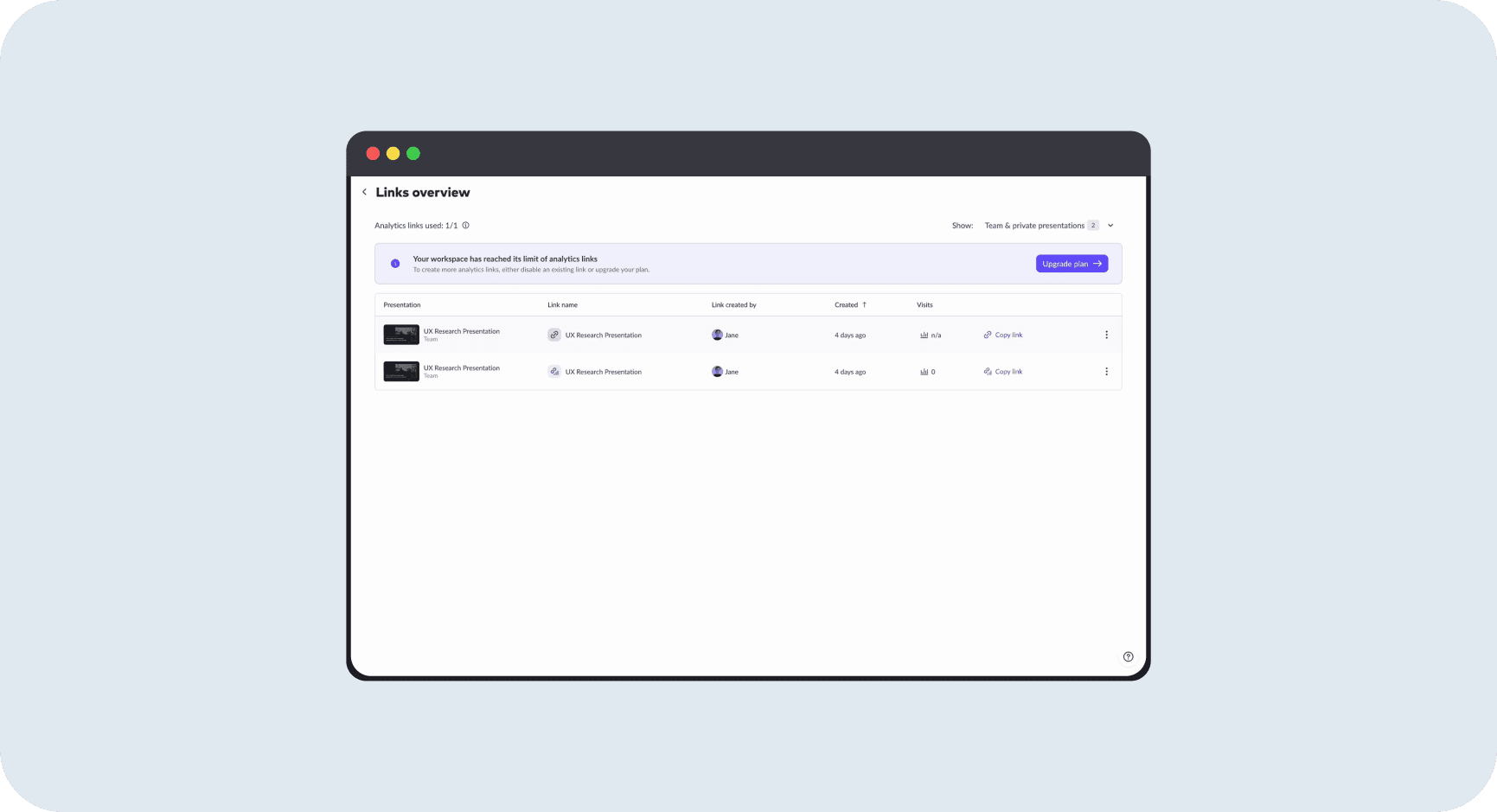
Showing the exact count used against the plan limit with an upgrade path in the banner, so users understand the constraint without a surprise wall

Pitch
The design decision
Pitch shows "Analytics links used: 1/1" at the top of the Links overview page: a persistent count in the header, not buried in settings. When the workspace hits the limit, a banner appears immediately: "Your workspace has reached its limit of analytics links. To create more analytics links, either disable an existing link or upgrade your plan." The upgrade CTA sits in that same banner. The user can see the count, understand the constraint, and act without leaving the screen.
Why it works
Most products hide usage counts in billing settings, where users only look after something has gone wrong. Pitch surfaces the count in the page header where the relevant work happens, so users internalize the limit before they hit it. The banner also offers a non-upgrade path (disable an existing link) which reduces the feeling of being cornered. When a hard limit is unavoidable, explaining it clearly and offering an alternative action converts better than a single-option paywall. [4]
Showing What the Premium Feature Does Before Blocking Access to It
Blurring the premium content in context lets users understand exactly what they would get before asking them to pay for it
Letting Users Reach the Gate Inside the Workflow That Needs the Feature
Showing premium options in their disabled state with a clear explanation of why lets users understand the value before they are asked to pay for it
Mistakes That Kill Success
avoid this
Gating the Feature That Creates First Value
If users need a feature to understand why your product matters, locking it removes the context needed to want to pay. Casey Winters' framework is direct: if a capability drives activation to long-term retention, the economics usually favor leaving it free until activation is achieved. The gate should appear after users have seen the product work, not before. [10]
Fix
Run Casey Winters' four-question audit on every gated feature: does it drive virality, activation, lifetime value, and is the support cost worth what you'd gain by giving it away? If a feature is necessary for users to understand the product, it belongs in the free path or behind a short trial, not behind a paywall.
avoid this
Moving Broadly Useful Features to Enterprise-Only Plans
Algolia's case is the clearest warning: gating features that are valuable across all customer sizes behind enterprise plans can improve ACV while quietly damaging the self-serve engine that generates pipeline. For horizontal SaaS, the enterprise gate should be reserved for security, governance, support, and scale, not for product innovation that helps users of all sizes understand the value. [2]
Fix
Before moving a feature to enterprise, ask whether it is broadly useful across customer sizes or specifically useful only at enterprise scale. If the former, consider usage-based or role-based gating instead of hard access denial for non-enterprise customers.
avoid this
Treating Packaging as an Annual Finance Exercise
Most teams set gate structure once and watch it calcify. Thresholds that made sense at 1,000 users rarely make sense at 100,000. Gate placement should be driven by behavioral data on where users actually hit limits and what they do next, not by what seemed logical when the pricing page was last redesigned. [8]
Fix
Instrument gate hits as a first-class metric. Log paywall impressions, quota-remaining states, over-limit attempts, and feature consumption by plan. Review monthly and run threshold tests the same way you'd run any other experiment, with holdout groups and defined primary metrics before the test starts.
Metrics That Matter
Gate Performance Metrics
A gate that no one hits is not a monetization lever. A gate that everyone hits but converts at 2% is a messaging problem. These metrics tell you which situation you're in. [30]
Core Formulas
Gate-hit rate = users who reach the limit / total active free users
Gate conversion = upgrades from gate moment / gate hits
Feature consumption by plan = usage events per feature / users on that plan
Revenue and Expansion Metrics
ChartMogul's expansion research shows median ARR contribution from upsells and expansions at 19% in their survey, and crossing 100% NRR is a key milestone. Gate changes that improve conversion but worsen churn are not wins. Evaluate both together by cohort. [33]
The Opportunity
19%
Median ARR contribution from upsells and expansions in ChartMogul's survey, the downstream revenue that well-placed gates unlock once users have experienced enough value to want more [33]
Gate Second-Order Value
The consistent pattern across Slack, Zapier, Figma, Notion, and Miro: protect first value on the free plan, gate what appears when usage becomes serious. Automation, integrations, admin controls, and governance sit behind the gate. The loop that teaches the product usually doesn't. [1]
Visible Limits Convert Better
Specific quota thresholds ("3 boards," "100 tasks," "10 users") outperform vague "upgrade for more" messaging because they make the boundary legible and the next step obvious. A hidden limit is punitive; a visible meter is predictable. [31]
The Algolia Warning
Aggressive feature differentiation can boost deal size while quietly damaging the upstream engine that made those deals possible. If a feature is broadly useful across customer sizes, an enterprise-only gate is often the wrong lever, even when it temporarily improves ACV. [2]
Downgrade Design Shapes Win-Back
View-only modes, automatic free-plan fallbacks, and "upgrade to restore access" framing all outperform hard locks on win-back rate. The downgrade should feel like a pause. Products that delete data or lock accounts on downgrade damage trust in a way that is expensive to reverse. [28]
Resources Worth Your Time