/
Free Trial → Paid Conversion
End-of-trial UX is not a single paywall screen. It is a state-transition system that moves accounts from trial into paid, free, read-only, grace period, or sales-assisted follow-up. The best systems optimize for more than immediate conversion. They protect trust, preserve long-term retention quality, and make the post-trial state unambiguous.
what would you do?
Your 14-day trial conversion rate looks healthy at 18%. But first-month churn is 45%. Finance is unhappy. What is the most likely root cause?
Pick the most likely explanation:
A
The trial is too short. Users need more time to evaluate the product before committing.
B
Users are converting at expiry to avoid losing access, but have not yet hit an activation milestone that would make them stay.
C
The pricing is too high. Users are cancelling when they see the first invoice.
D
The onboarding emails are not reaching users before trial end.
The Problem
Most end-of-trial experiences are designed around a single goal: get the user to click "Upgrade." That is the wrong objective. Trial conversion by itself is misleading if newly converted users churn quickly, and a high conversion rate with poor retention quality is worse than a lower conversion rate with users who stick. ChartMogul makes the same point in measurement terms: month-over-month raw conversion counts are too noisy. The meaningful view is cohort conversion at relevant post-signup day counts, such as day 14, 30, or 90. [2]
The end-of-trial moment also carries more trust weight than most teams acknowledge. Blinkist's timeline paywall (making the trial period and upcoming charge explicit upfront) reportedly increased trial starts by 23%, cut cancellations by 4%, and increased subscriber conversion by 9%. The mechanism is transparency: users who understand the timeline before entering card details are less likely to cancel when the charge arrives. Conversely, end-of-trial experiences that feel like traps (charges that appear without reminders, access that vanishes with no explanation, or downgrade states that feel like punishment) generate support tickets, chargebacks, and lasting negative impressions. [3]
OpenView's benchmark data adds the funnel context: free-trial products convert a materially larger share of signups to paid than freemium products, which means the end-of-trial moment is the highest-leverage conversion point in a funnel that is smaller but more monetizable. Getting the transition wrong costs disproportionately because the users who reach it are already the most qualified. [4]
The State Machine: What Comes After the Trial
The most defensible end-of-trial architecture is a state machine, not a pile of one-off messages. That machine must explicitly define what users can do in each post-trial state, who receives which notification, how billing failures are handled, and when accounts move from self-serve to sales-assist. [5]
Trial active → T-7 reminder → T-1 warning → Expiry state → Paid / Free / Read-only → Grace period if billing fails
Three default blueprints by product type
No meaningful free tier: Use an explicit expired-state banner or modal, then move the workspace to constrained read-only mode rather than a fully destructive hard stop. Preserves trust while keeping urgency real.
Meaningful free tier exists: Use a reverse trial or downgrade-to-free path, then use contextual feature and usage gates after expiry rather than repeated generic paywalls. Captures first-month urgency and long-tail conversion.
Team/admin-led B2B: Keep individual-user collaboration accessible enough to preserve adoption, but monetize organization-level controls: SSO, security, admin settings, invoiced billing, policy controls. Design the end-of-trial experience for the buyer and the user separately.
Billing failures deserve their own track entirely. Failed payments can account for 20 to 40% of subscription churn, yet most products treat "payment failed" identically to "user chose not to buy." The correct response is a grace period that preserves access while retries run, followed by dunning communications and an easy payment-update path before any hard lock. RevenueCat documents grace periods specifically for app-store subscriptions; Stripe recommends smart retries, customizable dunning emails, and automated reminders as the core mechanics. [6]
Real Examples
Making the Charge Visible Before the Card Field Appears
A timeline paywall that shows today, reminder date, and charge date before asking for payment, producing measurable lifts in trial starts, conversion, and cancellation rate

Blinkist
The design decision
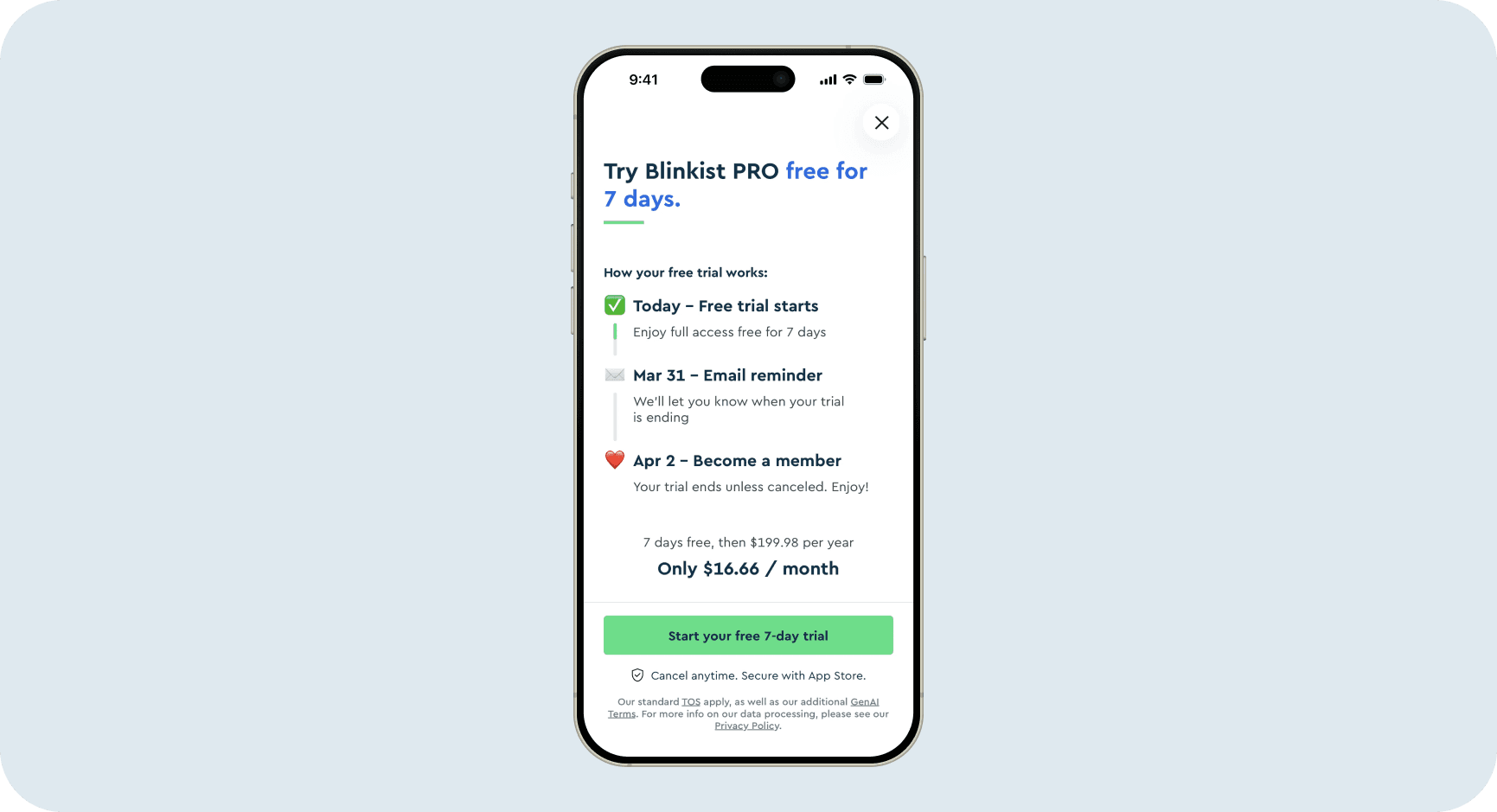
Blinkist's trial start screen shows three named calendar dates before any card details are entered. Today the trial starts with full access. On Mar 31, an email reminder arrives. On Apr 2, the membership begins unless cancelled. Below the timeline: "7 days free, then $199.98 per year (Only $16.66/month)." The CTA is "Start your free 7-day trial." Directly below it: "Cancel anytime. Secure with App Store." Lenny's Newsletter cites this pattern as producing a 23% increase in trial starts, a 4% reduction in cancellations, and a 9% increase in subscriber conversion.
Why it works
Three design decisions in the screenshot are worth noting separately. First, exact calendar dates ("Mar 31" and "Apr 2") rather than relative ones ("in 3 days") make the timeline concrete and memorable. Second, showing the annual total ($199.98) alongside the monthly equivalent ($16.66) does the math for the user rather than requiring them to calculate it. Third, "Cancel anytime. Secure with App Store" appears directly below the CTA, answering the anxiety that the button itself might create. Users who understand the full billing picture before they tap are less likely to cancel defensively when the charge arrives. [3]
Full Paid Access First, Then a Named Downgrade to Free
The reverse trial lets users experience premium before the payment decision, converting first-month urgency into genuine product attachment rather than deadline-driven buying
Recovering Revenue From Failed Payments Before Hard-Locking Access
Grace periods and smart retries preserve the user relationship during billing failures, preventing the 20-40% of subscription churn that comes from payment problems rather than product dissatisfaction
End-of-Trial Strategies at a Glance
The right strategy depends on whether a viable free tier exists, whether buying is individual or administrator-led, and how much setup cost the user has invested. These are directional heuristics, not universal benchmarks. [10]
Strategy | Best use cases | Conversion potential | Trust risk |
|---|---|---|---|
Hard lock at expiry | Simple products, low setup cost, strong urgency needed | Medium to high | High if work is lost or state is unclear |
Read-only workspace freeze | Collaborative SaaS, document and workflow tools | High | Low: work preserved, urgency maintained |
Reverse trial to free | Products with a meaningful free tier and strong premium differentiation | High, with long-tail tail | Low: no surprise, clear downgrade path |
Usage-cap gate | Storage, seats, sends, API calls, AI credits | High at threshold moment | Low if quota is visible throughout |
Feature-only gating with contextual upsell | Products with premium workflows and a usable free core | Medium | Low |
Team/admin gating | B2B tools with SSO, admin controls, invoiced billing | Medium to high | Low if individual users stay accessible |
Card-upfront opt-out trial | Mature categories, high-intent buyers, expensive-to-serve products | High in qualified segments | Medium: requires transparent timeline |
Grace period during billing failure | Subscription renewals, high-LTV accounts, consumer subscriptions | Medium for recovered revenue | Very low: preserves trust during a non-decision failure |
Mistakes That Kill Success
avoid this
Optimizing Trial-to-Paid Rate Without Tracking First-Month Churn
A trial-to-paid rate that looks healthy can mask a product that is converting urgency rather than value. Users who convert at expiry to avoid losing access (without hitting an activation milestone) and cancel after the first payment at rates that can make the trial-to-paid metric actively misleading. ProductLed recommends tracking beginner-milestone completion alongside trial-to-paid as the minimum viable double-check. [1]
Fix
Add first-month churn and activation milestone completion to every end-of-trial dashboard. If activation rates are low among converts, the conversion problem is upstream. The trial experience is not getting users to value before the deadline, and changing the expiry screen will not fix that.
avoid this
Treating Billing Failures as Voluntary Churn
Immediately locking accounts when a payment fails treats an operational problem as a product decision. The user whose card expired is not the same as the user who decided to cancel. Hard-locking failed renewals without a grace period generates support tickets, chargebacks, and avoidable cancellations. Vendor benchmarks suggest that 20 to 40% of subscription churn originates from billing failures rather than product dissatisfaction. [6]
Fix
Implement a grace period that preserves access while retries run, followed by a direct update-payment-method CTA before any hard lock. Track past-due recovery rate separately from voluntary cancellations. The two groups require different interventions.
avoid this
Sending Upgrade Messaging Only to the End User in B2B Products
In team products, the person using the tool every day is rarely the person with purchasing authority. Urgent trial-expiry messages sent only to end users create frustration without action. The user cannot upgrade even if they want to. Meanwhile, the admin who controls the purchase never saw the message.[8]
Fix
Route end-of-trial notifications to workspace owners and billing admins, not just the most active user. Preserve read-only access for end users while the admin makes the decision. For accounts above a defined seat or usage threshold, offer a quote or sales-assist path rather than only a self-serve upgrade option.
Metrics That Matter
Conversion Quality Metrics
The minimum viable metric stack connects activation, conversion, retention quality, and revenue impact. Raw trial-to-paid without first-month churn is an incomplete picture. Cohort measurement is more honest than same-month counts. [1]
Core Formulas
Trial-to-paid cohort = accounts paying at day 14/30/90 / accounts that started trial in same cohort
First-month churn = accounts that cancelled within 30 days of first payment / total new paid accounts
Activation rate = users who complete beginner milestone / trial starts
Expired trial to upgrade = upgrades within 14 days of expiry / expired trials
Benchmarks
Lenny's synthesis of benchmark data pegs "good" free-trial conversion for self-serve products at roughly 8 to 12% and "great" at 15 to 25%. OpenView puts average free-trial conversion materially above freemium in its dataset. But those headline rates only matter if the converted segment sticks. Track first-month churn alongside trial-to-paid to assess conversion quality, not just conversion volume.[2]
Revenue and Recovery Metrics
Downgrades, reactivations, and payment recoveries matter as much as outright conversions. ChartMogul's revenue-churn framework is the right lens: monitor gross and net MRR churn because both involuntary churn and expansion are part of the full picture. [3]
The Opportunity
23%
Increase in trial starts from making the charge date and timeline explicit before the card field appears, the Blinkist timeline paywall result cited by Lenny's Newsletter, alongside a 4% reduction in cancellations and a 9% lift in subscriber conversion [3]
Conversion Quality Over Conversion Rate
High trial-to-paid with high first-month churn means the end-of-trial experience is converting urgency rather than value. Track activation milestone completion alongside trial-to-paid. Users who hit the milestone before expiry retain at materially higher rates. [1]
20-40% of Churn Is Billing Failures
Vendor benchmarks suggest that 20 to 40% of subscription churn originates from failed payments rather than product dissatisfaction. A grace period and dunning sequence is a direct retention lever that requires no product changes, only billing infrastructure. [6]
State Clarity Drives Post-Expiry Conversion
ProductLed's Soapbox case found a "huge jump" in conversion after making the expired state unmistakable. A 20% conversion rate from a targeted usage-threshold email confirms that contextual triggers outperform generic nudges at the expiry moment. [7]
Free Trial Converts Better Than Freemium
OpenView benchmark data shows free-trial products convert a materially larger share of signups to paid than freemium products. The end-of-trial moment is the highest-leverage conversion point in a smaller but more monetizable funnel. Getting the transition wrong costs disproportionately. [4]
Resources Worth Your Time