/
Onboarding & Activation
Turn signup friction into activation fuel by choosing the right moment to ask for identity, so users reach first value faster, activate at higher rates, and convert without feeling pressured.
what would you do?
Your SaaS product requires account creation before users can do anything. Sign-up completion is fine, but activation is 18% and D7 retention is terrible. What's the most likely root cause?
You're seeing signups but not engagement. What's really happening?
A
Your onboarding emails aren't converting, send more of them.
B
The signup form has too many fields, reduce it to just email.
C
Activation benchmarks are just naturally low, 18% is acceptable for SaaS.
D
You're capturing users before they understand why your product is valuable, so they don't return.
The Problem
Account creation is frequently treated as a universal prerequisite. But the user's goal is rarely "make an account", it's "complete my task." Premature account prompts introduce distraction, uncertainty, and perceived commitment before users understand why signing up is worth it. [1]
The abandonment cost is quantifiable. In e-commerce, 24% of US shoppers report they abandoned carts in the past quarter solely because they were forced to create an account. That's not a UX preference, it's a measurable revenue loss. [2]
Even when a softer option exists, it often gets buried. Benchmark data shows a majority of sites fail to make guest checkout the most prominent option, meaning users behave as if it doesn't exist. [3]
In SaaS, the "first day" window is brutal. Research finds that 40, 60%+ of new users never return the next day, making every unnecessary pre-value step disproportionately expensive. The account gate is usually the first friction point, and often the most avoidable one. [4]
The Solution
Design account creation timing around a single principle: ask for identity at the moment it unlocks a clear, immediate benefit. That moment is usually one of: saving progress, collaborating, personalizing, exporting results, initiating a transaction, or setting up the core value loop. [5]
The 3-Second Clarity Test for Account Creation Timing
A user who hits your signup gate should be able to answer all five in about three seconds. If they can't, expect avoidable drop-off and low-quality accounts:
1) Can I continue without creating an account right now?
2) If not, what do I get immediately by signing up (save, share, sync, export, trial features)?
3) How long will this take, 1 step? 3 steps? Email verification?
4) What will you do with this data? Is it required, and why?
5) If I skip now, will I lose progress?
The strongest pattern across product categories is value-first, identity-second. This includes ungated "try now" experiences, guest checkout, and delayed account creation until a user attempts to save, share, complete a transaction, or otherwise "lock in" progress. PLG benchmarks increasingly describe ungated product experiences where users start immediately and only provide an email when they want to save. [6]
But "delay the account" isn't always right. When the account is a prerequisite to deliver value (team collaboration, security boundaries, data sync) or when you need qualification to ensure users get the right path, structured friction can improve downstream quality. One pre-signup survey flow slightly lowered signups but produced users who subscribed at a 10% higher rate. [7]
Real Examples
Full Content Access, Gate Only at Interaction
Gate at the moment of social intent, not at the door so signup feels like unlocking, not blocking [10]

TikTok
The design decision
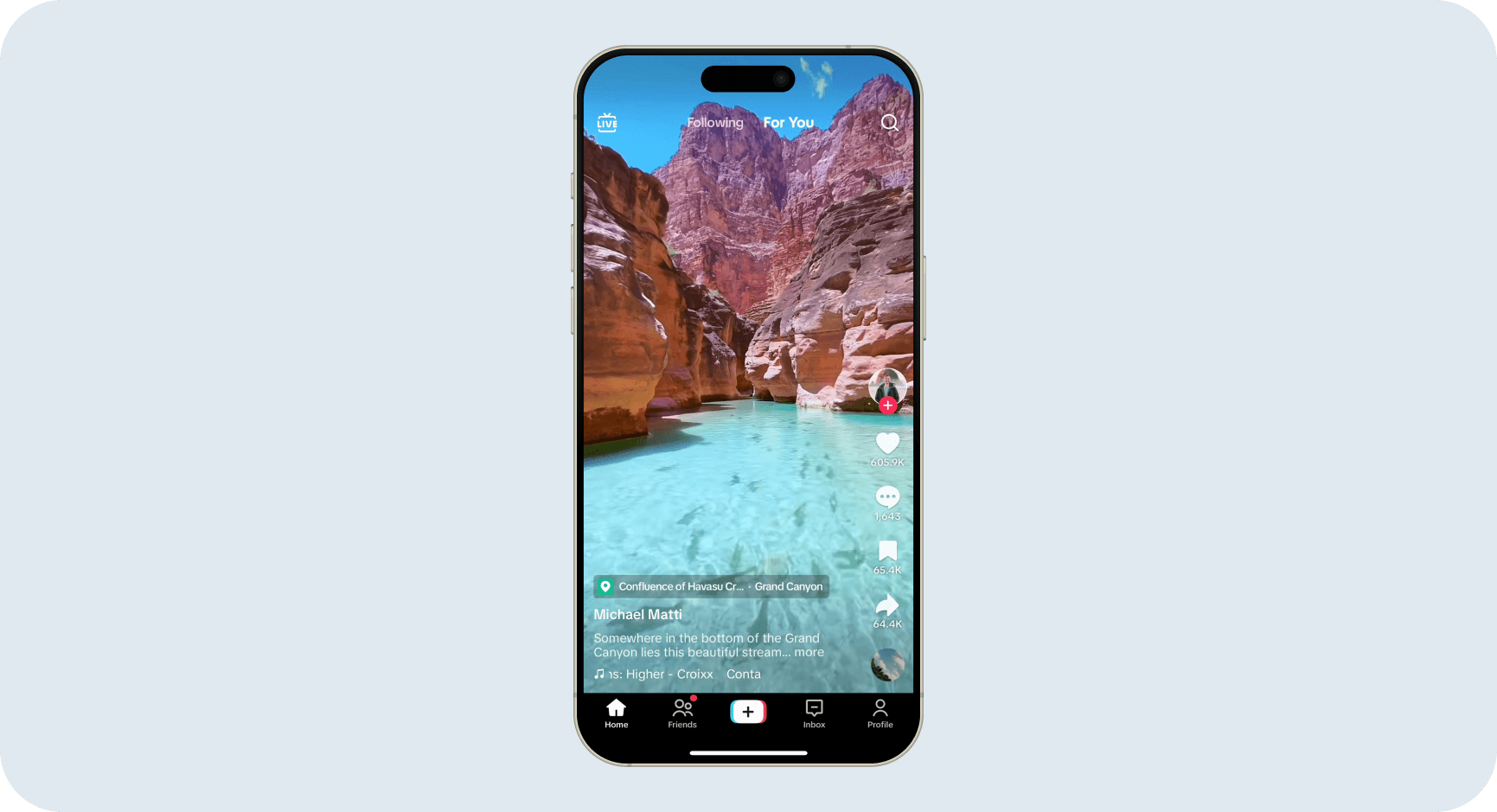
TikTok's For You feed is fully accessible without an account. Users can scroll, watch, and consume an unlimited stream of content. No hard gate interrupts the experience. Instead, signup is triggered only when a user attempts an action that requires identity: liking a video, following a creator, or commenting. The engagement actions (heart, comment, bookmark, share) are visible in the interface at all times, creating constant soft reminders of what signing up unlocks.
Why it works
The gate appears at peak intent, when a user has seen something they want to react to. By the time they tap the heart icon, they've already received significant value and have a specific reason to sign up (this video, this creator). That's a far stronger conversion moment than a wall at the door. The persistent visibility of locked actions (like, follow, comment) functions as a lightweight engagement nudge on every piece of content, without interrupting the experience. This mirrors the same principle behind Pinterest's +50% conversion lift from gating at scroll depth rather than entry. [10]
How to measure
Measure visitor-to-account conversion segmented by trigger (like-prompted vs. follow-prompted vs. comment-prompted signups). Track activation quality: did the user engage with their first feed after signing up, or bounce? Signup counts without engagement data is a misleading signal here, you need identity stitching to connect pre-signup watch time to post-signup behavior.
Account Creation After Task Completion
Ask for identity after a completed win, when the account clearly preserves something the user already values [11]
Pre-Signup Survey That Filters for Intent
Use pre-signup questions as personalization, not gatekeeping — filters for intent while building commitment [12]
Timing Strategy by Product Category
The right default varies by product type. This table consolidates the most robust strategies based on observed outcomes and large-scale UX research. [14]
Product Type | Default Strategy | Gate Trigger | Key Metric |
|---|---|---|---|
B2B Enterprise | Account first, reduce friction via SSO | Entry, but minimum fields, defer profile | Visitor → trial conversion; activation rate |
B2B Self-Serve SaaS | Ungated sandbox or email-first | Save, export, or invite teammates | Start-to-activation rate; signup completion |
Consumer Freemium | Browse first, account for personalization | Save, follow, or personalize | Visitor → signup; D7 retention |
Marketplace (Demand) | Browse freely, gate at transaction | "Contact seller" or "Book now" | Transaction-start rate |
Marketplace (Supply) | Account earlier, then guided setup | Creating a listing | Listing completion; time to first listing |
E-commerce | Guest checkout prominent; account after purchase | Order confirmation page, not cart | Checkout completion; post-purchase account creation |
Mistakes That Kill Success
avoid this
Forcing Account Creation Before Any Meaningful Output
This converts "interest" into "hesitation." Large-scale checkout research shows forced account creation is a direct abandonment driver, 24% of US shoppers report abandoning solely because of it. In SaaS, it captures low-intent users who inflate signup metrics while depressing activation. [2]
Fix
Map your first meaningful output. Then put the account gate there, not at the door. Ask: what does the user have to lose by not creating an account? That's your gating moment.
avoid this
Offering Guest Checkout But Hiding It
Benchmark data shows a majority of sites fail to make guest checkout the most prominent option. When users can't find it, they behave as if it doesn't exist, and either create an unwanted account or abandon entirely. [3]
Fix
Guest checkout should be visually primary or at minimum equal to account creation. If it's a text link below a prominent button, most users won't see it. Apply the same hierarchy principles you'd use for a CTA.
avoid this
Requiring Email Verification Before First Value
Early verification walls are harmful. Onboarding guidance explicitly calls them out and recommends delaying verification or using less disruptive safeguards. Verification emails go unread, get filtered, and create a gap that most users never return from. [15]
Fix
Let users access the product immediately. Verify email at a natural moment: when they invite a teammate, publish something, or trigger a transactional action where email delivery matters.
Metrics That Matter
Acquisition Metrics
Website → account created conversion rate is the core constraint for self-serve. One PLG analytics guide targets 3, 6%+ for website-to-signup conversion and calls <2% a clear problem. Some leaders reach significantly higher. [18]
Core Formulas
Visit → account created = accounts created / unique visitors
Registration completion rate = completed registrations / registration starts
Field-level drop-off = users who abandon at field X / users who reached field X
Activation Metrics
Activation is not "signed up." It's the first measurable moment a user experiences the product's core value. Benchmark research suggests typical activation medians around 25% across products, and around 30% for SaaS specifically. [18]
Retention Metrics
If account timing increases low-intent accounts, it inflates acquisition while depressing retention. Treat retention and churn as guardrails for any signup or gating change, never as secondary considerations. [13]
Resources Worth Your Time