/
Acquisition & First Impression
Your first impression lives or dies in 3 seconds. Craft headlines that instantly communicate value and subheads that seal the deal.
what would you do?
You run two A/B tests on your landing page headline.
Version A: "The AI-powered project management platform" = 2.8% conversion
Version B: "Ship projects 2x faster without the chaos" = 5.6% conversion
You want to test a third headline. Which one performs best?
A
"Project management software trusted by 10,000+ teams"
B
"Stop missing deadlines. Start shipping on time."
C
"Built for teams who ship fast"
D
"Your team's command center for getting work done"
The Problem
Landing pages fail because headlines are unclear or uninspiring. Visitors bounce within seconds [2].
Vagueness kills engagement. Generic phrases like "Innovative platform" or "Next-gen solution" mean nothing. Without a specific promise, people scroll away. GoodUI shows changing vague headlines to benefit-driven ones significantly improves signups [2].
Misaligned expectations break trust. Click an ad about "Fast project tracking" but see "Optimize Your Workspace"? Trust is gone. Unbounce notes matching the headline to the ad's promise creates a seamless transition [3].
Unclear value propositions get ignored. Too-short headlines without supportive subheads confuse users. Elena Verna: "Your headline must clearly communicate the value of your offering" [1].
No emotional hook = no connection. Headlines stating features ("Task Manager") lose to those tapping aspirations ("Never Miss a Deadline Again"). Emotion converts better than facts.
The Solution
The 3-Second Clarity Test
In 3 seconds, visitors must know: (1) What is this? (2) What's the benefit for me? (3) Who is it for?
Formula:
Headline: [Main benefit] for [target audience]
Subhead: [How it works] + [Supporting proof/detail]
Example:
Headline: "Automate Your Team's Workflows"
Subhead: "Connect 1,000+ apps and save 10 hours/week with no-code integrations"
Answer: Who, What, Why. Strong headlines answer "What's in it for me?" The subhead adds how or why. This tells users what (automation), why (save time), and how (integrations).
Use "you" and pain points. Headlines speaking directly to users perform better. "Tired of Endless Meetings? Get More Done" addresses pain. Unbounce highlights DoorDash focusing on driver benefits, not features[4].
Be specific and vivid. Adding numbers or concrete outcomes helps. Changing "Learn design" to "Land your first UI/UX job" made a course headline much more compelling[2].
Subheads expand, not repeat. The subheadline should complement the headline by adding context. If the headline is "Save Hours Every Week", the subhead might read "Automate billing and HR tasks with one simple tool"[1].
Patterns for High-Converting Headlines
Dual Benefit Statement
Two complementary value props in one headline [3]

Slack
How they do it
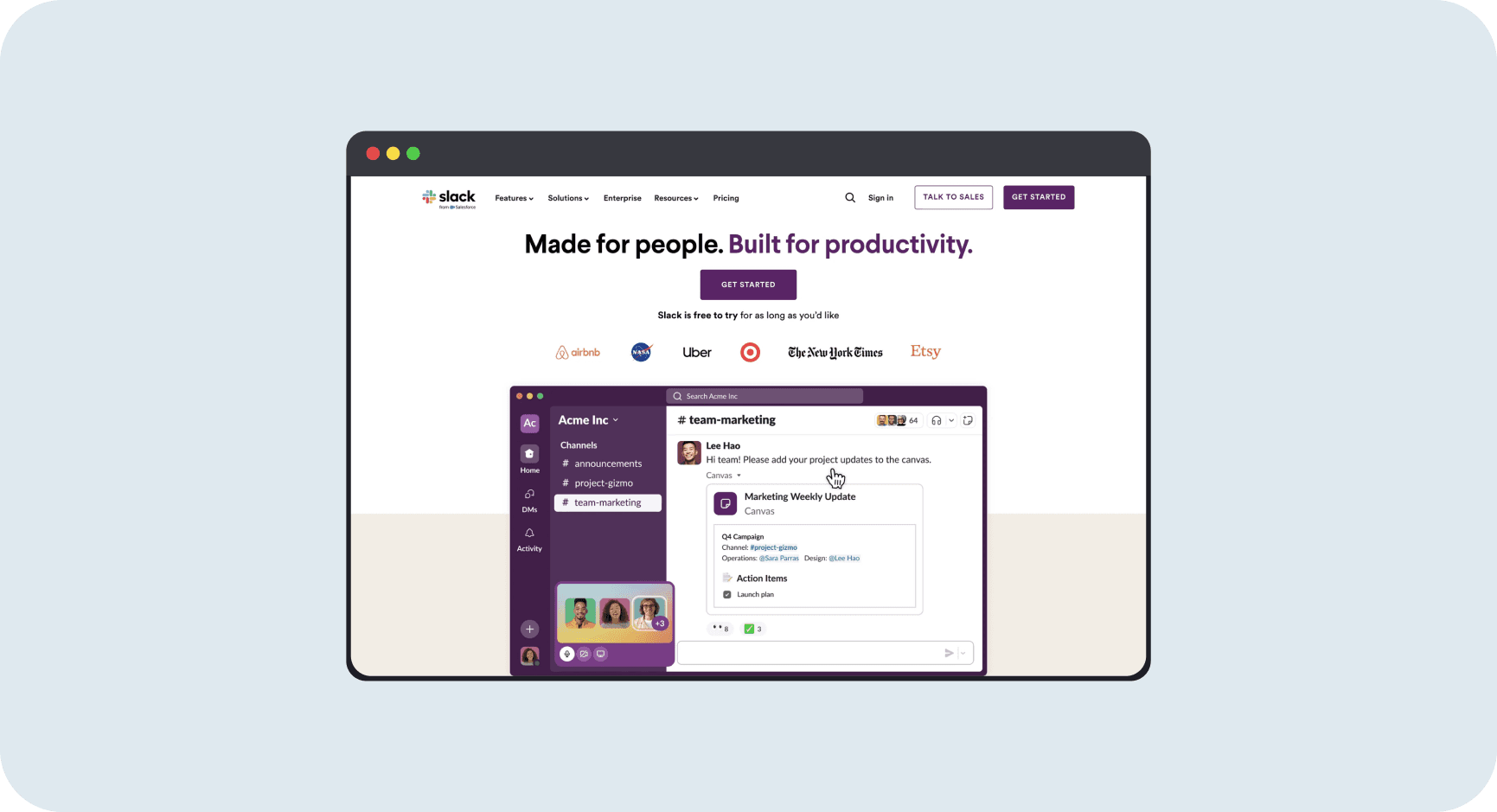
Slack uses "Made for people. Built for productivity." The headline splits into two parts: "Made for people" (human-centered design) and "Built for productivity" (business outcome). Below that: "Slack is free to try for as long as you'd like" removes time pressure. Logos from Airbnb, NASA, Uber, Target, NYT, and Etsy provide massive social proof. The product screenshot shows the actual interface with channels, DMs, and collaborative features.
Why it works
The period between the two phrases creates a pause that emphasizes each benefit equally. "Made for people" addresses user experience concerns (will this be pleasant to use?). "Built for productivity" addresses business concerns (will this drive results?). Both audiences get their answer in seven words. The logos provide instant credibility without cluttering the message. No jargon, no buzzwords, just clear positioning.
Aspirational Transformation
Verb your noun approach makes abstract concrete [2]
Mission-Driven Positioning
Broader purpose attracts values-aligned customers [5]
Headline Types by Product
Different products need different headline approaches. Match your copy to your customer's mindset and buying journey.
Product Type | Headline Focus | Example | Why It Works |
|---|---|---|---|
B2B SaaS | Efficiency & ROI | "Close deals 40% faster" | Time/money savings resonate |
Consumer Apps | Aspiration & Fun | "Learn Spanish in 10 min/day" | Achievable dreams, low commitment |
E-commerce | Value & Selection | "10,000+ styles, free shipping" | Choice + no-friction checkout |
Enterprise | Security & Trust | "Protect your business 24/7" | Risk reduction, reliability |
Developer Tools | Speed & Clarity | "Turn spreadsheets into APIs" | Direct transformation promise |
Mistakes That Kill Success
avoid this
Vague Jargon Instead of Clear Benefits
Headlines like "Revolutionizing Workflow" or "Next-gen Solutions" don't tell visitors what's in it for them. GoodUI found replacing vague headlines with specific, benefit-driven ones significantly increases conversions [2].
Fix
Replace "Revolutionizing Workflow" with "Ship projects 2x faster." Test feature-free headlines that state outcomes, not processes. Ask: Does the user know the benefit after reading this?
avoid this
Company-Focused Instead of User-Focused
Headlines about the company ("Our AI Platform") lose to those about the user ("Automate your tasks"). CXL's test showed that focusing on reader benefits boosted newsletter signups [2].
Fix
Flip every headline to "you" language. "Our platform helps businesses" becomes "Save 10 hours per week." Lead with second-person benefits, not first-person features.
avoid this
Missing or Weak Subheadlines
A short headline without supporting detail leaves visitors confused. The subhead must provide context. Without it, even good headlines underperform.
Fix
Always pair headlines with subheads that expand on the promise. Headline: "Automate Your Workflows." Subhead: "Connect 1,000+ apps without code—save 10 hours/week." The subhead adds how and quantifies benefit.
Metrics That Matter
Hero CTA Click-Through Rate
Percentage of page visitors who click the primary CTA. Strong headlines drive this number up.
Benchmark
Strong landing pages: 10-30% CTR. Below 5% signals headline/subhead aren't compelling.
Formula
CTR = (clicks on CTA ÷ page views) × 100
Test benefit-focused vs feature-focused headlines
Compare headlines with vs without numbers
Measure first 3 seconds of visitor attention
A/B test emotional vs rational language
Bounce Rate
Fraction of visitors who leave without interaction. High bounce often means the headline failed to hook them.
Conversion Rate
Signups or trials divided by total visitors. Engaging headlines lift this metric directly.
The Business Impact
20%
Conversion increase from changing a vague headline to a clear, benefit-focused one. Higher conversions mean more revenue without increasing ad spend.
CXL Newsletter Test
Changing headline to emphasize benefits drove significant signup jump. Clear value propositions convert better than vague promises [2].
Lower CAC from Ads
Matching ad copy to landing headlines prevents drop-offs. Even 5% better conversion from paid traffic improves ROAS substantially. Optimize before scaling [1].
Better User Targeting
Headlines that accurately set expectations attract genuinely interested users. This can lower churn. Users acquired via targeted headlines are more likely to activate.
Compounding Growth
100k visitors/month with 10% CTR = 10,000 clicks. Increase to 12% CTR = 12,000 clicks (+2,000). More clicks = more signups without extra traffic spend. Small percentage gains compound.
Resources Worth Your Time
Frameworks & Testing
Strategy & Growth